By Alessandro Ferrini

In 1888, during excavations for the construction of a military fortification on the summit of the Talamonaccio hill, the remains of the ancient Etruscan city were unearthed. This is what Gamurrini, one of the scholars who began the archaeological investigations, recounts:
“The summit of the Talamonaccio hill was, in Etruscan-Roman times, occupied by a small city which, to the southeast, overlooked the Via Emilia and the mouth of the Osa River, and to the west, the port and the sea inlet. It was enclosed by a double circuit of dry-stone walls, now almost entirely dismantled and covered by earth: the first outer one about a kilometer long, the other inner one at a short distance from it. The houses, frequently built with walls and lime-glazed floors, followed Roman methods and measurements. The city flourished, as inferred from the underlying necropolis, in the third century BC and may have been founded slightly earlier.”
(Notizie degli Scavi di Antichità, year 1888)

In reality, the area had been inhabited since ancient times, as evidenced by various toponyms. Known as Telamòn by the Greeks, it became Tlamun in the Etruscan period and Talamo under the Romans, whose influence grew due to its proximity to the Via Aurelia.
Its port was always a key point for coastal navigation, but in Roman times, it was also famous for the great battle that took place there in 225 BC. This battle saw the Roman consular army fight against a coalition of Celts, which included the Boii, Senones, Taurini, and Insubres, who were also joined by the Gesates from beyond the Alps.

Remains of the Etruscan temple’s pediment at Talamonaccio (Archaeological Museum of Florence)
Polybius recounts that for this battle, 50,000 infantry and 25,000 cavalry were gathered. The allied army outnumbered the Roman forces, which consisted of four legions under the command of consuls Gaius Atilius Regulus and Lucius Aemilius Papus, supported by allied Sabine and Etruscan contingents.
The battle, which the historian Polybius described in detail, took place on the plain known as Campo Regio, between the Osa stream and the Albignaccia ditch near present-day Fonteblanda. Approximately 40,000 Celts were killed, and another 10,000 were captured, including one of their kings, Concolitanus. The other, Aneroëstes, managed to escape with a few followers.
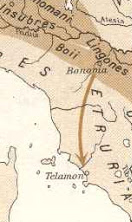
The Celtic coalition’s march towards Rome
In 1913, during the construction of the new railway line, a vast necropolis was discovered on the right side of the Osa River, likely containing the remains of soldiers who perished in the bloody battle. The skeletons were found at a shallow depth, haphazardly piled up. Many exhibited clear signs of blunt-force fractures, suggesting it was a mass grave for the defeated Celts. An interesting find was the presence of female remains, as the Gesates had brought their wives with them when they descended into Italy.
Talamone’s history in the Roman period includes other significant events, such as the landing of Tiberius Gracchus upon his return from Numantia in 137 BC and that of Gaius Marius returning from African exile in 87 BC. After delivering his demagogic proclamation from the heights of Talamonaccio, exalting liberty and justice, the conqueror of the Cimbri and Teutones marched on Rome at the head of troops recruited in Mauretania and volunteers from various parts of Etruria.

Due to its unintended support for Gaius Marius, Talamone was later devastated and sacked in 82 BC by Sulla’s army, which had defeated and killed his rival.
Click here for The Battle of Talamone narrated by Polybius, where the historian provides a clear and detailed account of the battle’s phases and events.
 tuttatoscana